

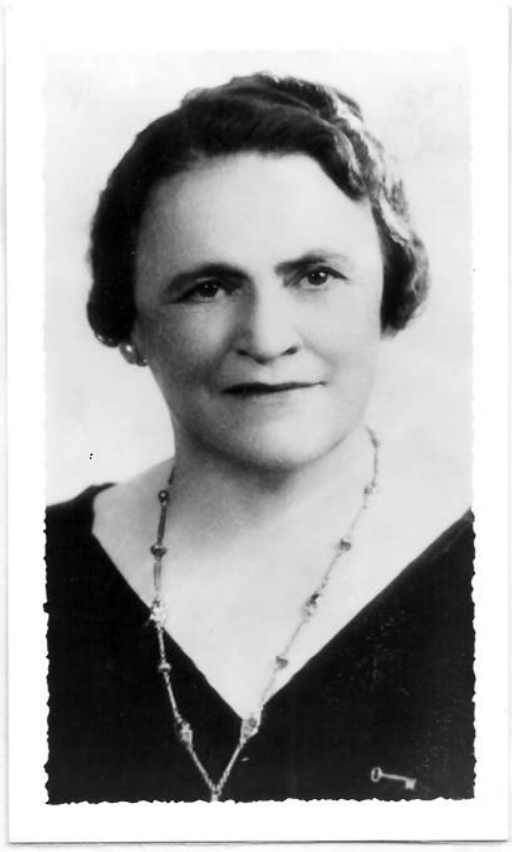
Bertha Stevenson,
Civic Leader and Utah Minute Woman
1883 - 1957
BY KATIE CLARK BLAKESLEY
Bertha Ester Starley Stevenson believed in seeking opportunities to do good, fostering cooperation, and expanding roles for women, in her church, community, and on the World War II home front. Born in Fillmore, Utah on June 16, 1883, Bertha loved to play the organ, attended and later taught public school in Fillmore, and graduated from Brigham Young Academy in 1901. She married Lester Alanson Williams Stevenson on December 17, 1902, and they had 9 children. A lifelong learner, Bertha studied music and art in Chicago while Lester attended medical school, enrolled in summer school at the University of Vienna where Lester did graduate work, and enjoyed university correspondence courses for over a decade.
Bertha served in the LDS Young Ladies Mutual Improvement Association (YLMIA) for over twenty years as President, Board member, and author. In 1921, Bertha was “very anxious to broaden the scope of activity of all girls,” and worked with local YLMIA President May Green to develop, organize, and implement the Gleaner program for older girls in the Granite Stake. The Gleaner program, which lasted for fifty years, was adopted church-wide in 1922.[1]
As her children matured, Bertha sought new places “where she could do good.”[2] Bertha was involved in various clubs and became president of the Auxiliary to the Salt Lake County Medical Society in 1937, where they not only assisted nurses, but helped lay the groundwork for establishing the Utah Symphony (established in 1940). In 1938, she was elected to a two-year term as President of the Salt Lake Council of Women (SLCW), coordinating city-wide efforts among 49 Salt Lake clubs representing 10,000 women. Referred to as President Mrs. L.A. Stevenson in the minutes, Bertha emphasized wholehearted participation and trusted her board members to lead. She believed in “women’s important part in civic life and of the advantages for accomplishment in united effort.”[3]
Under her leadership, the work of the Council blossomed, and the relationships she made would continue to impact her life. The women cooperated with existing organizations, pooled resources, and mobilized members to reach their stated goals. The Council partnered with civic groups to plant trees, address city issues including beautification, save historic sites such as Eagle Gate, and built. They gave “active cooperation to all civic problems such as safety, smoke elimination, garbage disposal, and street repairs,” and Bertha gave radio programs to keep residents abreast of the Council’s accomplishments and plans.[4] She hosted visitors from South America, and attended countless meetings, teas, receptions, and other events. Led by Bertha, the SLCW worked with city and state leaders to solve problems and influence legislation, and organized events on affordable housing, conservation, and winter sports. The SLCW worked with community partners to raise money for important causes, including nearly $4,000 for Finnish relief in 1940.
In 1942, Grace D. Wahlquist, Bertha’s close friend and predecessor as President of the SLCW was appointed as the State Chairman for the Women’s Salvage Division of the War Production Board. Grace, tasked with organizing the Utah Minute Women—a women-run home front salvage organization—quickly appointed Bertha as the Salt Lake City Minute Woman Chairman. Bertha Stevenson used her connections, forged in over 25 years as a YLMIA worker, club woman, and President of the SLCW, as well as her experience organizing women, running meetings, running print and radio campaigns, making assignments, and rallying women to a good cause, to organize one of the most successful women’s salvage organizations in the country. She immediately appointed a board of “able, capable women,” women she had worked with before and could trust for this long-term war effort, and got to work.[5]
The organization of the Salt Lake Minute Women was “spectacular,” and at the first board meeting on September 7, 1942, Ada Fisher, herself a former SLCW President, shared her plans to appoint 1100 block captains within the week. They sent letters to women, drafting them to “serve in a volunteer war job for the duration,” and the majority of the women responded immediately to the call.[6] Five days later, Bertha organized the first mass salvage meeting at the Capitol Theater—nearly 1,000 woman showed up. At the end of the war, Bertha oversaw 13 Committee Members, 9 District Chairwomen, 92 Area Captains, 1778 Minute Women, and 2000 Paper Troopers (children who collected waste paper for the salvage effort).
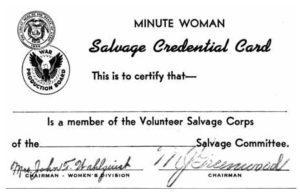
From Utah Minute Women, World War II,1942-1945.
The Salt Lake Minute Women held 69 board and planning meetings, 10 mass meetings, and thirty-five special drives. They organized waste paper drives, silk and nylon hosiery drives, and collected millions of pounds of household fats, tin cans, rubber, scrap metal, and more. Bertha Stevenson and her board organized mass meetings, pep rallies, coordinated with department stores on publicity and as drop off sites for salvage, canvassed from door to door, sponsored lectures, gave radio announcements, and coordinated the transport of massive amounts of materials. The Minute Women were recognized nationally for exceeding every quota. At the end of the war, Bertha Stevenson and Grace Wahlquist wrote to all 1778 Salt Lake Minute Women, expressing pride in their contribution to the war effort. On October 17, 1945 Bertha was honored alongside 21 other MW Leaders with a gold Minute Women medal. Later that day, all 8,000 Utah Minute Women were invited to a large reception at the Hotel Utah to celebrate their combined 54 million volunteer hours in the Minute Women cause.
Bertha Stevenson remained active in her church and women’s clubs and was inducted into the SLCW Hall of Fame in 1953. Upon her death on October 17, 1957, her friend and fellow SLCW past President Ethelene Gregerson remarked, “Her charm, culture, and ability will ever be an everlasting benediction to the Council of Women and to those who knew and loved her.”[7]
Katie first discovered the Utah Minute Women as a student two decades ago and is happy to revisit this incredible story. She loves women’s history, hiking, tacos, sunshine, skiing, and good books.
[1] Salt Lake Stake. “Gleaner Scrapbook, circa 1930-1949,” n.p., LR 604 58. Church History Library, The Church of Jesus Christ of Latter-day Saints, Salt Lake City, Utah.
[2] Bertha Ester Starley Stevenson (Mrs. L.A. Stevenson), “Personal History,” 1949, 1. Copy in the possession of the author.
[3] Minutes of the General Meeting of the SLC Council of Women,” September 12,1938, ACCN 1069, Box 5, folder 7, Salt Lake Council of Women Collection, Special Collections, J. Willard Marriott Library, University of Utah, Salt Lake City, Utah.
[4] “Council History Scrapbooks, 1940-1950,” n.d., ACCN 1069, Box 7, Salt Lake Council of Women Collection, Special Collections, J. Willard Marriott Library, University of Utah, Salt Lake City, Utah.
[5] Bertha Ester Starley Stevenson (Mrs. L.A. Stevenson), “Personal History,” 1949, 2. Copy in the possession of the author.
[6] Grace D. Wahlquist and United States of America War Production Board, Conservation and Salvage Division, Utah Minute Women, World War II,1942-1945 (Utah, N.P.,1945),18, 49.
[7]“Reports, Attendance, Correspondence, Minutes,” ACCN 1069, Box 15, Salt Lake Council of Women Collection, Special Collections, J. Willard Marriott Library, University of Utah, Salt Lake City, Utah.