

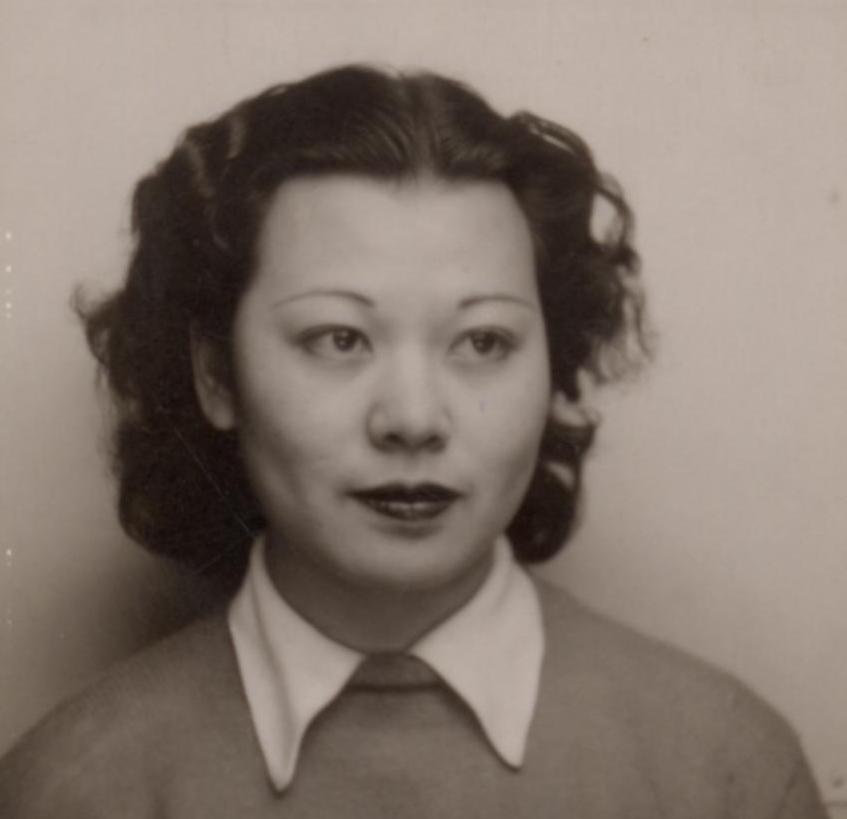
Miné Okubo,
Japanese American Artist and Advocate
1912 – 2001
“I hope that things can be learned from this tragic episode, for I believe it could happen again.”
BY CARLY BAGLEY
WOMEN’S HISTORY INITIATIVE PROGRAM ASSISTANT, UTAH HISTORICAL SOCIETY
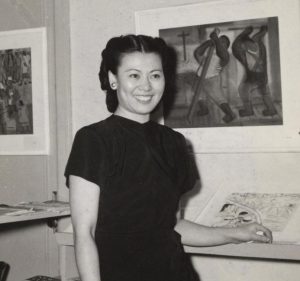
Bancroft Library, UC Berkeley.
Miné Okubo was born on June 12, 1912 in Riverside, California to Japanese immigrants Tametsugu and Miyo Okubo. While in Japan, Miné’s father was a scholar, and her mother was a talented calligrapher with an honors degree from the Tokyo Art Institute. However, when her parents immigrated to the United States, her father was forced to work more modest jobs and her mother had little time for her art work with their large family.
Encouraged by her mother to pursue her interest in art, Miné excelled in school. She attended Riverside Junior College in 1931 and received a scholarship to attend the University of California, Berkeley. There, she earned both a Bachelor of Arts and a Master of Arts degree in art and anthropology. Because of Miné’s distinguished academic honors, in 1938, she earned the Taussig Traveling Art Fellowship, which allowed her to study, travel, and paint in Europe for two years under the direction of artist Fernand Léger.
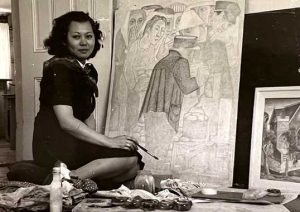
Miné in her Berkeley studio, 1940. UC Merced.
Unfortunately, Miné’s time in Europe was cut short. In September 1939, World War II broke out, and she was stranded in Switzerland for a period of time. Miné also received news that her mother was ill. Luckily, Miné was able to pass through France and board the last ship leaving Bordeaux for the United States. When she returned home, Miné worked by painting murals for the Works Progress Administration’s (WPA) Federal Art Project. For one of these murals, she worked alongside famous Mexican artist Diego Rivera.
Miné’s life dramatically changed on December 7, 1941 when Japan attacked Pearl Harbor. This attack exacerbated national security fears and persistent anti-Asian racism. On February 19, 1942, President Franklin D. Roosevelt signed Executive Order 9066. This act forcibly removed and incarcerated people of Japanese ancestry. The large Okubo family was split up, and Miné and her brother were sent to the Tanforan Relocation Center, a former racetrack, in San Bruno, California. They shared a horse stall together and slept on sacks of hay. They were later transferred to the Topaz Internment Camp near Delta, Utah.
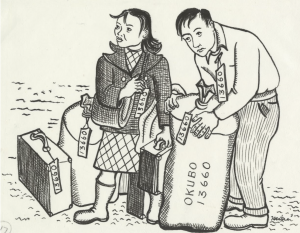
Miné and her brother Toku standing with their luggage, Berkeley, California, 1942. From Citizen 13660.
Camp life in Topaz was often characterized as crowded and boring. The weather was frequently harsh with very cold winters and very hot summers. Despite these difficult circumstances, Japanese people inside the camp were resilient and made the best of their situation. Miné continued to sustain her love of art. Cameras weren’t allowed in the camps, but Miné could document by drawing, creating more than 2,000 drawings portraying everyday life at camp. Additionally, Miné worked as the illustrator for the camp’s newspaper, the Topaz Times, and acted as the art editor for Trek, a literary magazine. In addition to her publication roles, Miné also taught art lessons to children, adults, and seniors who lived in Topaz.
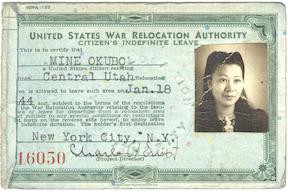
Mine Okubo’s leave pass, 1944. Japanese American National Museum.
In 1944, Miné’s work in Trek drew the attention of Fortune magazine, and she was asked to go to New York City as an illustrator. She received special permission to leave the camp early, and her first assignment was to provide illustrations for an article on Japan. Very shortly after WWII ended, Miné compiled her many drawings from her time at Topaz and published her book, Citizen 13660, in 1946. The title of the book comes from the government-issued number given to Miné when she was first incarcerated. Citizen 13660 was the first incarceration camp experience to be published from the perspective of a former prisoner.
Miné had a long and interesting career in commercial art and also as a full-time painter. After the Commission on Wartime Relocation and Internment of Civilians was formed in 1981, Miné appeared before the committee and testified about her experiences and how her artwork connected with internment. In 1988, Congress passed the Civil Liberties Act of 1988, which recognized the illegal removal of people of Japanese ancestry from their homes during WWII. Citizen 13660 won the American Book Award in 1984, and Miné continued to paint until she passed away in 2001.
Carly Bagley is the Utah Women’s History Initiative Program Assistant for the Utah Historical Society. This Initiative seeks to amplify women’s stories in Utah’s larger historical narrative, deepening our collective understanding and appreciation of the many roles women play in Utah’s history.