


Additional Resources
Suzy Rytting,
Women's Skiing Pioneer
1930 – 2022
By Emily Peterson, Former Better Days Outreach and Research Coordinator
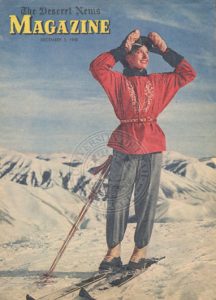
Suzy featured on the front of the Deseret News Magazine in 1948. During this time, skiers received more media attention than today, as sports like basketball and baseball were not yet popular in Utah. University of Utah Marriott Library Special Collections.
Suzy began skiing after moving to Utah in the early 1940s. Her family was unfamiliar with the sport, but she quickly fell in love with racing down the slopes in Salt Lake Valley. Suzy would become an early trailblazer for women in professional skiing, challenging barriers and paving the way for the next generation of female skiers.
Considered a “late bloomer,” Suzy excitedly entered her first race only one year after she began skiing at age 12. Lacking any formal coaching, ski patrollers used glass Coke bottles to walk Suzy through the basics of ski racing before the competition. Although she lost the race, she found it invigorating and eagerly began entering every race she could. Suzy’s confidence grew as she started taking lessons from Alf Engen, a famous Norwegian-American ski athlete of the time and namesake of Park City’s Alf Engen Ski Museum.
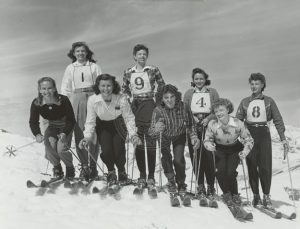
1948 US Olympic ski team. Suzy is #8.
After competing for only 3 years, Suzy was selected for the 1948 Winter Olympic Team to compete in Switzerland. This was only the second time women were allowed to ski in the Olympics. Although Suzy ultimately did not compete because she was the least experienced team member, qualifying for the team pushed her to continue to train hard for the next Olympics. Amidst her training, Suzy also married her husband, William Rytting, and attended the University of Utah.
In 1950, Suzy was selected to compete on the first United States women’s skiing world championship team (a competition separate from the Olympics). Two years later, Suzy qualified again for the 1952 Olympic Team in Norway. However, she discovered she was a few weeks pregnant after arriving in the Olympic village. Suzy was kicked off the team and forced to return to the United States immediately, even though doctors said she could compete and Utah newspapers offered to have her stay and report on the games.
The president of the Olympic Committee at this time believed women should stay out of the Olympics. Many leaders didn’t feel like women’s sports were important and expressed that women should only compete in more feminine sports like figure skating. Their lack of support resulted in women like Suzy feeling targeted because of their gender. Reflecting on the incident later, Suzy commented, “If you have a broken leg, they will drag you all over and pay your way, but they wouldn’t even let me do that…I was treated like a criminal.”[1]
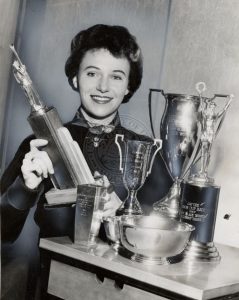
University of Utah Marriott Library Special Collections.
However, despite her discouraging treatment in the Olympics, Suzy kept competing. By the end of her professional ski career, she was an eight-time national medalist and nominated as one of the top ten women in 100 years of Utah history.
Suzy’s experience dealing with sexism inspired her to mentor female skiers by starting “Women’s All Stars” races in Park City. In created a junior ski club that included both boys and girls, during a time when they were usually kept separate. She also helped fundraise to support the Salt Lake City 2002 Winter Olympics.
As an early trailblazer for women’s skiing in the state, Suzy remains a valuable role model for athletes in Utah as someone who never gave up and paid it forward to support the future of women in sports.
Emily Peterson is a history BA graduate of Brigham Young University assisted as outreach and research coordinator for Better Days. She is currently completing a Master’s in public history at the University of Maryland Baltimore County.
[1] Rytting, Suzy. Interview by Joseph Arave. April 6, 1990, in Salt Lake City, UT. Transcript. University of Utah Ski and Snow Sports Archive, Salt Lake City, UT. 24. https://collections.lib.utah.edu/details?id=827473